- AGS Events
- Meetups
- News
- Magazine
- Media Partners
- About

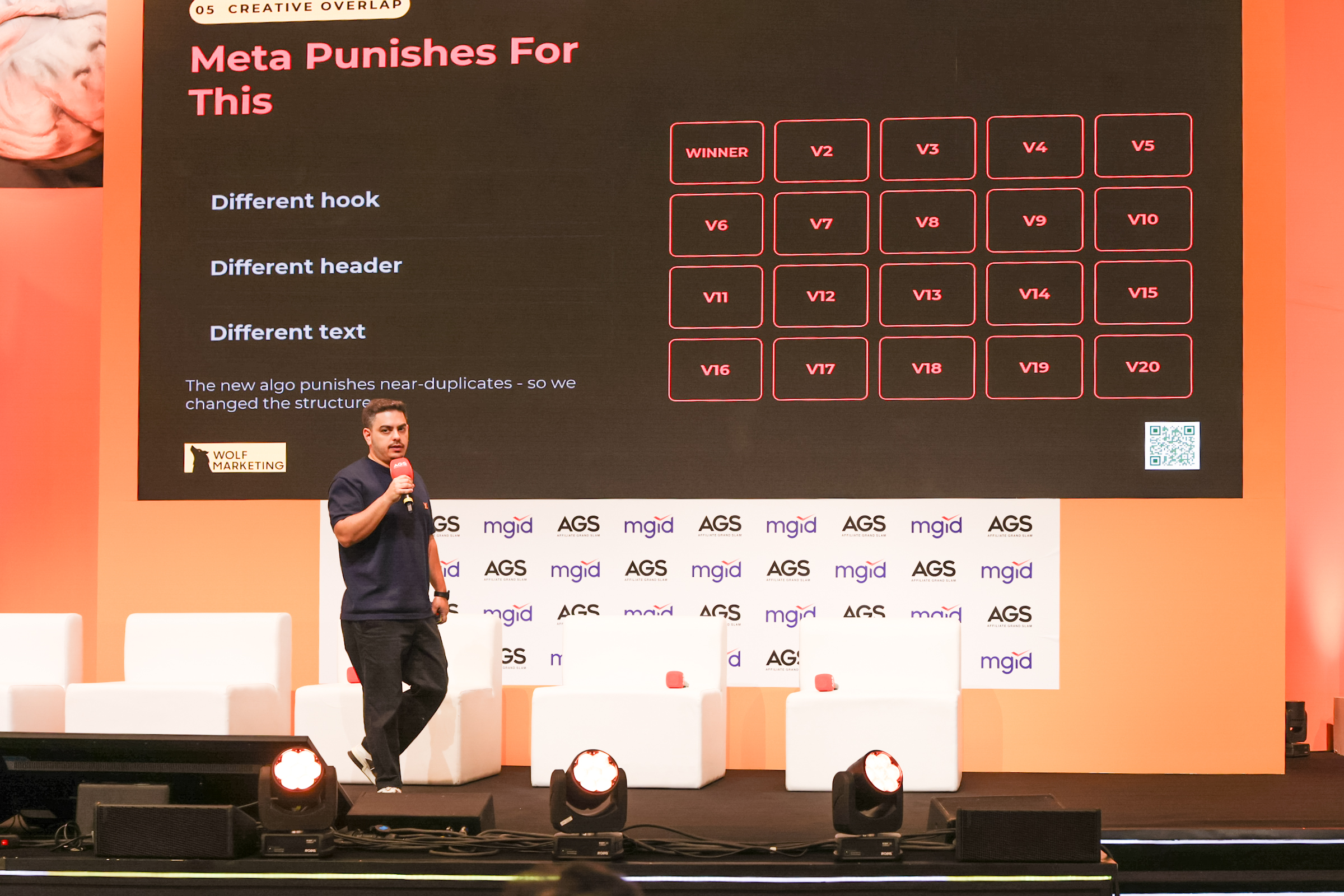
Maor Benaim unpacked Meta advertising at AGS Rome 2026 on 03 November. The Wolf Marketing CEO presented Forcing Meta’s Hand: Post AI-Era Adjustments Behind a $300k/Day Meta Account on Day 1. He shared lessons from spending $300,000 a day, focusing on tracking, bidding and creative testing. Reaching that figure outside the fourth quarter, he said, demanded preparation across the account.
Benaim started with tracking, an area he believes advertisers overlook while discussing creatives and funnels.
“The pixel is everything. It’s the algorithm. Without that, it doesn’t matter which creatives, which funnels, and what A/B testing you’re doing,” he said.
His account audits had uncovered large e-commerce brands that relied solely on browser tracking after their server connections stopped working.
He urged advertisers to check both sources and send Meta every event, not just the purchase. That includes basket additions and checkouts, with high event-match quality across both. For Benaim, scaling Meta advertising starts with giving the algorithm reliable information.
He also stressed deduplication. Skipping it can be as bad as not sending events at all, he said, because the algorithm gets less data to find the right audience. His other recommendations were advanced matching, which is not on by default, and restricting incoming events to the relevant domain.
Benaim does not judge an advertorial’s potential through cost per acquisition alone. He also checks engagement, click costs, add to cart and checkout activity. Strong early signals can identify ads worth testing with manual bids, even when their initial purchase costs look high. In his approach, those ads may continue attracting traffic after he lowers the bid.
The main goal, he said, is to get campaigns out of learning mode. Benaim carries existing engagement into new campaigns by reusing the original post ID. He then starts with a higher budget than usual so that the campaign can reach enough conversions. Without about 50 conversions in a short time, a campaign turns learning-limited and performance drops. When a campaign spends its full daily budget, he lowers its bid by 5% to 10% in the next daily cycle and waits until the new day to do so.
His comparisons between bidding methods also raised a question about customer quality. Lowest-cost campaigns had initially frustrated him through higher acquisition costs and unpredictable spending. Yet, his tests found fewer refunds and chargebacks among customers acquired through that approach. He still uses cost caps for scale and predictability, while continuing to test lowest-cost campaigns. The cheaper acquisition did not automatically produce the better customer in his results.
Benaim also described changing his campaign structure after Meta’s Andromeda update. Previously, he tested ads with separate ad set budgets before moving winners into campaigns with shared budgets. His newer approach combines testing and scaling in a single campaign, using up to 5 ads. He leaves that campaign untouched for at least three days so it can exit learning mode.
He also described using spending limits to direct budget towards tests that might otherwise receive little traffic. This addresses a familiar frustration: one advert absorbs most spending while other ideas barely get a chance.
His own mistakes included producing minor variations of winning ads, such as small text changes or different opening seconds. He said those narrow iterations became less effective after Andromeda, prompting him to rethink the approach.
Benaim’s final Meta advertising tactic involved custom events across the funnel, including basket additions, checkouts and purchases. He argued that advertisers often compete for buyers showing similar signals around the same products. Custom events, he said, helped his campaigns reach audiences with less overlap.
He said Meta can check audience overlap for managed accounts, across an ad account, a page or a brand. When Meta ran that check on his campaigns, it found only around 4.3% overlap between custom and standard events. He also reported lower click costs, impression costs and acquisition costs in his tests. Those findings came from his accounts, which send both browser and server signals. He suggested testing custom events alongside an existing campaign to compare the results.
AGS Rome 2026 is presented by TrafficStars. It connects advertisers with premium inventory across global markets, offering both self-serve and fully managed campaign options.
Join the conversation at AGS Rome, taking place from 02–05 November 2026, where affiliates, advertisers, and performance marketers are sharing insights shaping the industry. Visit Affiliate Grand Slam for the full programme and event details.