- AGS Events
- Meetups
- News
- Magazine
- Media Partners
- About

AI is changing much more than how quickly media buyers can launch a campaign. It is making products easier to build, putting more advertisers in competition for the same traffic, and moving campaign execution, data, creatives and even moderation further towards automation. At PropellerAds, AI is embedded across the platform rather than offered as a standalone feature. It supports audience matching, traffic filtering, campaign optimisation, bidding, creative workflows and routine campaign management across multiple traffic sources.
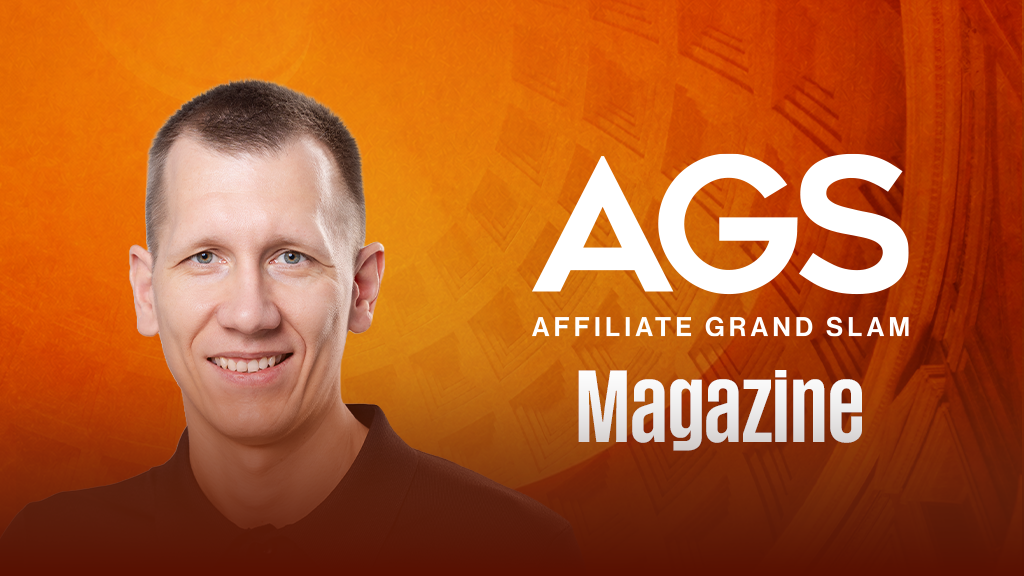
Alex Vasekin, CEO of PropellerAds, talks about six trends changing traffic buying and what media buyers need to do about them. His insights draw on what PropellerAds sees across an ecosystem reaching 2 billion+ monthly active users and thousands of campaigns launched by advertisers worldwide.
AI has made it much easier to build and launch a product. You no longer necessarily need a large development team, years of experience, or the same budget it once took to get something to market.
Alex has seen that change happen quickly.
“A year ago you still needed a team to ship a product. Now, one person with an AI agent ships an app over a weekend”.
The numbers back that up. According to Appfigures data reported by TechCrunch, new app releases across the App Store and Google Play grew 60% year over year in Q1 2026, and 80% on iOS alone. By April, releases across both stores were up 104% compared with April 2025. Appfigures links that growth to AI coding tools that allow people without mobile development skills to ship software.
That lower barrier to entry also means more products are reaching the market, often competing for the same audiences. More products mean more offers, more advertisers buying traffic and more competition for attention. So Alex doesn’t expect that traffic to get any cheaper.
How you respond depends on which side of the market you’re on.
For product developers, Alex sees two approaches. One is to focus on fewer, more polished products with stronger retention and lifetime value. That could produce a big winner, but there’s no guarantee which one will take off. The other is to launch more products, shorten development cycles and use AI to increase production. Alex leans towards the second because volume gives you more chances to find what works.
For affiliates running offers, more products can mean more opportunities. Every new product creates another offer that someone needs to promote, giving affiliates a wider pool to test. So those who can automate more routine work can move through them faster and scale what performs well.
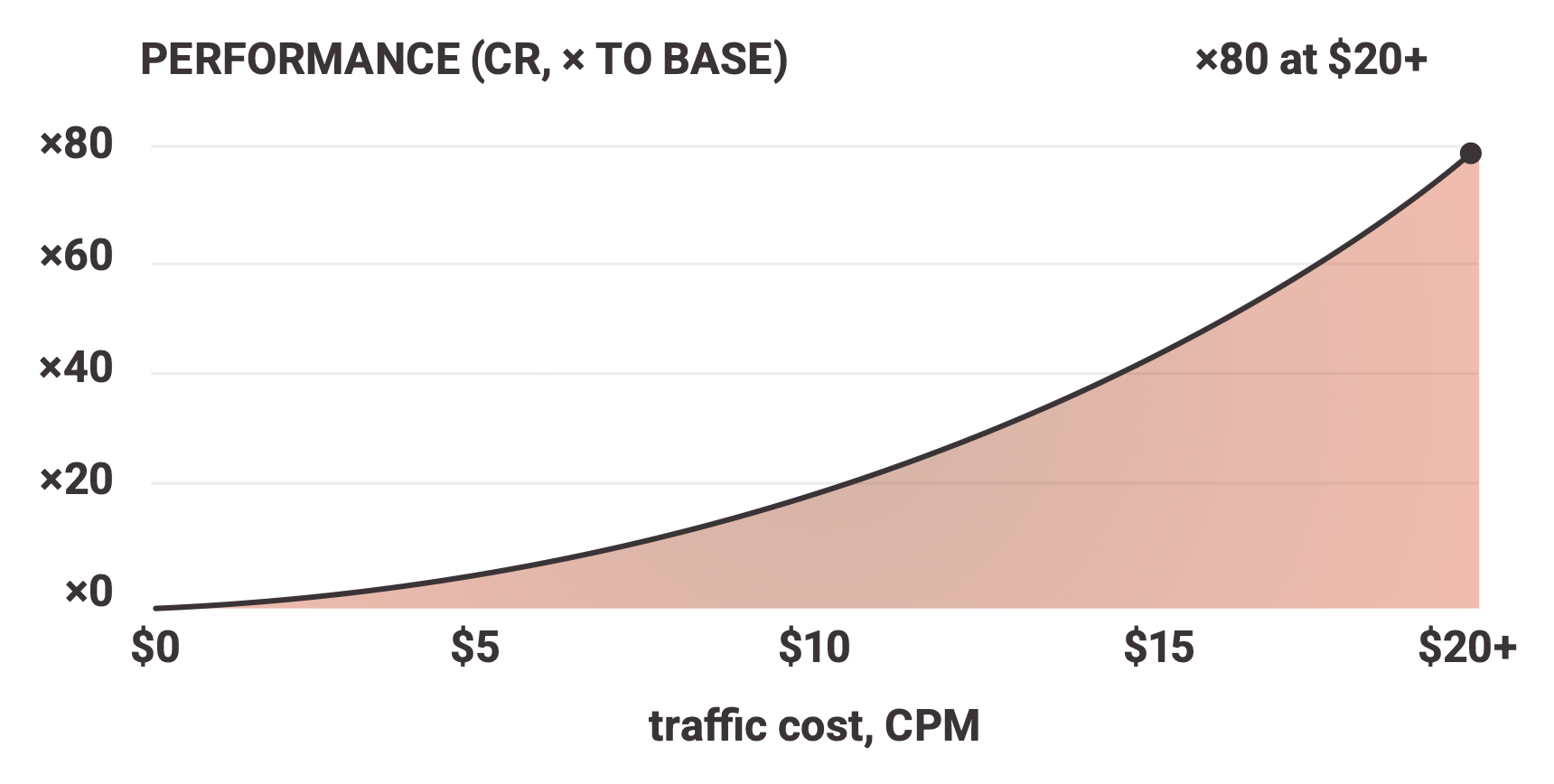
For media buyers, the challenge is properly pricing that traffic. PropellerAds analysed 1,000 US placements and more than 100 million impressions and found that cost per mille (CPM) for similar traffic could vary by as much as 1,000 times. More expensive tiers also tended to bring higher-quality conversions.
One bid can only get you so far. Buyers can split campaigns across low-, medium-, and high-cost tiers to see where the strongest conversions actually come from. Some of the most advanced buyers go much further, working across 30 to 40 bid levels.
The opportunity is still there, but taking advantage of it means moving faster and getting much more precise about what you’re willing to pay.
The next shift is happening in the buying itself. Setting up campaigns, adjusting bids, checking placements and cutting weak performers can increasingly be handled by scripts and AI agents.
PropellerAds is already seeing campaign creation increase as AI adoption widens. The number of campaigns created per advertiser grew by 42% in four months, with the sharpest increase coming after a new generation of AI models arrived in February 2026. Alex expects that growth to continue as more campaigns are launched and managed through scripts, application programming interfaces (APIs) and AI agents. He estimates campaign creation could grow 5 to 10x over the next 12 to 18 months if that pace continues.
From there, the route depends on how much automation a buyer already has in place.
For buyers who don’t already have their own automation system, PropellerAds built NIKO AI Agent into its Self-Serve Platform (SSP). A media buyer can describe an offer in a chat, and NIKO AI can turn that brief into a live campaign in minutes. It can then continue working on the campaign by adjusting settings, removing weak zones, scaling the stronger ones and reporting the results. According to PropellerAds’ internal data, the first launch can be around 5x faster than doing it manually, while 52% of NIKO AI users come back to use it again.
On the other hand, buyers who already have an automation system can use PropellerAds’ open-source model context protocol (MCP) connector, which plugs their existing AI agent directly into the platform and gives it access to PropellerAds’ campaign workflow at scale.
Alex has already seen this play out in practice.
In one case, PropellerAds media buyers used AI-assisted coding to build a tracking system in one week. It has since been stress-tested at more than 200 million impressions per day. Another case involved a media buyer with no development experience. He described his buying logic to an AI agent, connected it to the platform, and used scheduled scripts to execute the decisions. A week in, it was making $500 profit per day and about 60% return on spend (ROS). And that was just one media buyer on one traffic source. But this was a specific case and may not reflect typical results across all media buyers or traffic sources.
That doesn’t remove the media buyer from the process. It just shifts their time away from manual launches and routine adjustments and towards the decisions the system still needs from them.
As more of the traffic buying process becomes automated, the system still needs to know what a good result looks like.
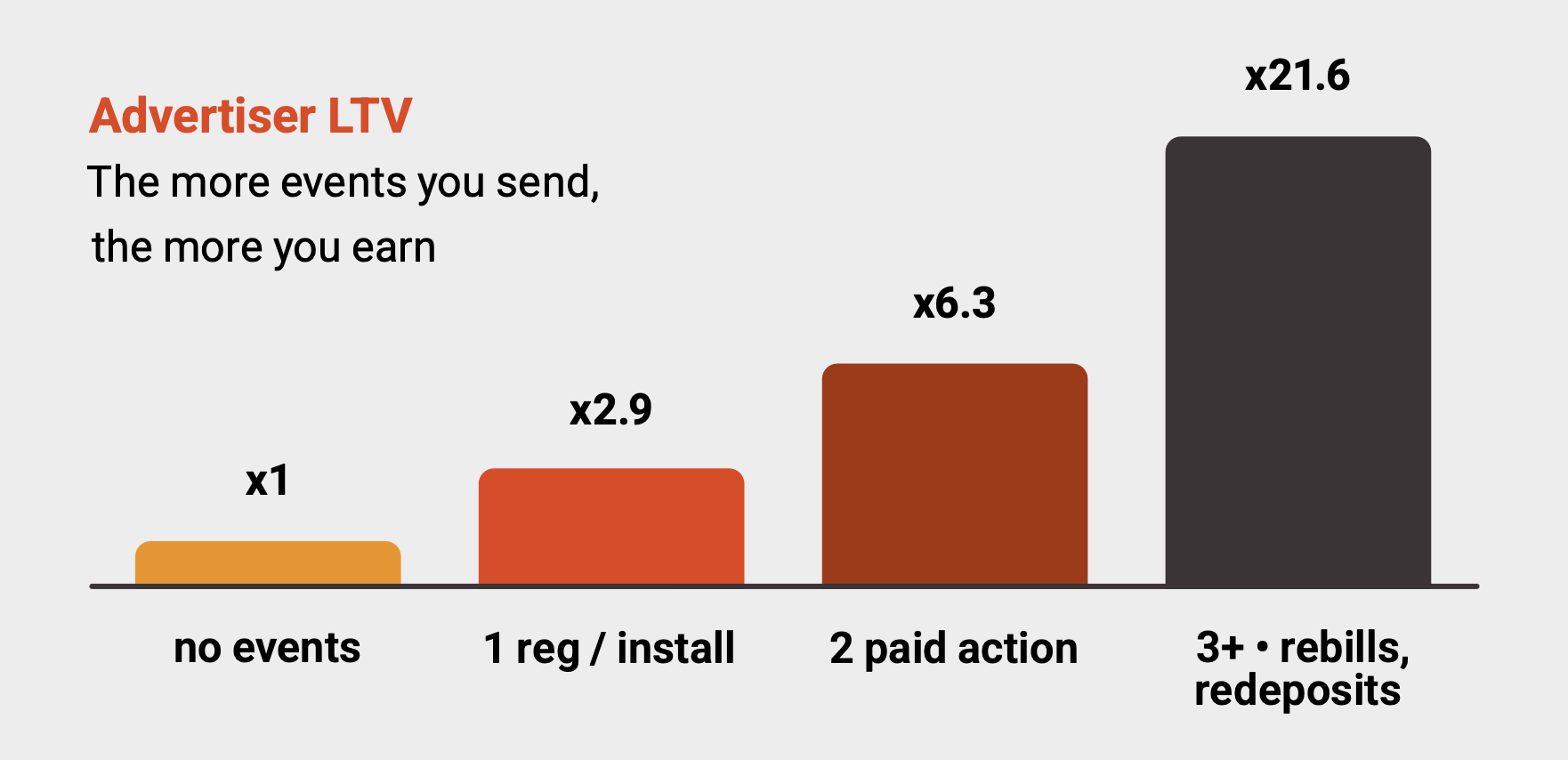
A registration tells the network something. A paid action tells it more. Rebills, redeposits, and other deeper funnel events give it an even clearer picture of which users are actually creating value. That makes conversion data much more important than simply telling the platform that someone clicked or completed the first action.
PropellerAds analysed advertiser accounts in Q2 2026 and found that advertisers reporting a registration or installation recorded 2.9x the lifetime value of those that sent no events. Adding a paid action raised the figure to 6.3x the baseline, while accounts that also reported rebills and redeposits reached 21.6x the baseline. These figures reflect PropellerAds’ internal data for that period, and individual results may vary.
Some advertisers are still hesitant to share conversion data, but Alex is firm on the trade-off:
“The algorithm optimises on your funnel events. If you send nothing, it has nothing to learn from, and you pay for guesswork.”
Sharing more of the funnel gives the network more to optimise against. Instead of stopping at the first conversion, it can start learning which users are more likely to generate revenue further down the line. That can also feed into conversion audiences. The platform can identify users who have already converted and target them again in separate campaigns.
With those deeper signals, the network has a better chance of optimising towards value rather than just volume.
Conversion data tells the network what is happening inside the funnel. Hyper-personalisation goes a step further: the network can also start learning about the advertiser behind the campaign.
That can come from campaign history, previous results and business goals. Conversations with account managers, support teams and NIKO AI can add another layer of insights.
So not every new campaign has to start from zero. PropellerAds saw this across more than 2,000 new advertisers. Accounts with more in-depth conversations had activation rates 3x higher than those with limited interactions.
That’s where hyper-personalisation starts getting more specific to the advertiser. Campaign history can show what has happened, while conversations can add more details around it. The platform can learn which markets they work in, what they are trying to achieve and what has worked for them before.
Over time, that gives the network a clearer picture of how the advertiser operates. Instead of relying only on campaign performance, it has more context to work with when deciding what to recommend next.
Campaign setup isn’t the only part of traffic buying becoming more automated. Creative production is moving in the same direction.
Advertisers no longer have to produce every creative manually before launching a campaign. Google’s Performance Max can generate creative assets using information from a website, while TikTok’s Symphony can turn a product page into video ads. Adoption is growing too. Meta reported that 8 million advertisers used at least one of its AI creative tools in Q1 2026, twice as many as in late 2024.
PropellerAds follows the same approach. Buyers using NIKO AI can launch and manage campaigns while the platform’s Auto Creatives feature handles creative generation separately. If advertisers don’t upload their own creatives, the platform can automatically generate and select creatives that match the offer. NIKO AI can then turn existing creatives on or off and update details on creatives already attached to the campaign.
As more of that production becomes automated, simply having more banners or variations becomes less of an advantage. What happens after the click starts to carry more weight.
Pre-landers, progressive web apps (PWAs) and the rest of the post-click experience are still where buyers can shape how the offer is presented, warm up the audience and move users towards conversion.
Creative volume alone won’t be enough. AI can take more of the production work off their hands, but the funnel still has to do its job.
The same AI technology speeding up campaign launches is also changing how those campaigns are reviewed.
AI-powered moderation and monitoring can identify many policy violations much faster than manual reviews. Networks are also getting better at linking related activity and taking action against accounts associated with campaigns that break the rules. That leaves far less time for strategies built around slow moderation or grey areas to keep working.
For media buyers, that changes the value of compliance. Running transparent funnels, completing verification and providing accurate information are no longer things you do to avoid having a campaign stopped. They also put advertisers in a better position to keep campaigns running without unnecessary disruption.
Trust and performance start getting closer together. Buyers who provide the network with reliable information and run campaigns that the network can confidently approve are also in a stronger position to continue scaling.
For Alex, the bigger shift is not that AI is becoming another tool for media buyers. It is becoming more like the operating system behind how traffic is bought and managed.
NIKO AI is one part of that system. The broader change is that AI reduces operational friction and continuously improves how traffic, audiences, and campaign settings are matched to performance goals.
But that doesn’t make the media buyer less important. It changes what they need to be good at. Automation can support campaign launches, adjust settings, process more data, and handle repetitive tasks, while creative generation can also happen through the platform. Buyers still need to decide what to promote, how the funnel should work, which signals should guide optimisation and when human judgement is needed.
Alex puts it simply:
“Stop treating AI as one more tool in the drawer. Let it run the routine and step in when it’s wrong.”
This article was originally published in AGS Magazine. Explore the latest issue for more in-depth interviews, straightforward analysis and informed perspectives from across the affiliate and performance marketing industry.